
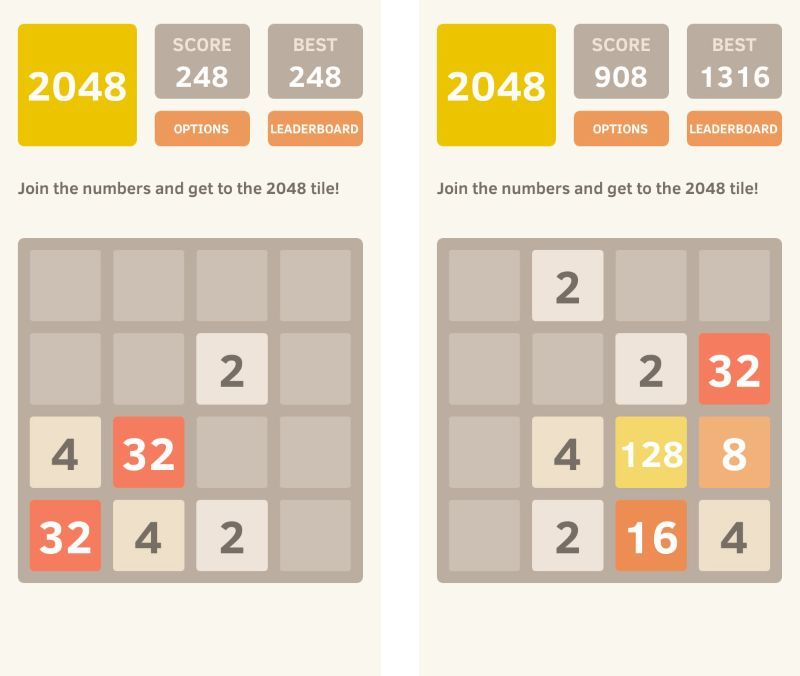
To beat 2048, keep your board organized by protecting one corner and merging tiles in a clean value chain while managing new spawns.
Follow 7 steps: lock your biggest tile in one corner, use a two direction swipe rhythm, build a merge chain with partner tiles, protect empty spaces, control the small tile zone, use Up only when safe, and maintain a descending edge ladder.
If 2048 feels frustrating, play a few quick rounds of Basketball Stars to reset, then return and make cleaner moves.
Read the guide below to learn How to beat 2048 with a simple, repeatable strategy you can use right away.
2048 is a resource management puzzle disguised as a simple swipe game.
Every move does two things at once: it merges tiles and it spawns a new tile.
Winning means controlling both outcomes by keeping your grid organized.
Your goal is not “merge whenever possible.” Your goal is “merge while protecting a corner and maintaining a clean chain of values.”
Choose one corner for your largest tile and commit to it for the entire run. Bottom right and bottom left are the most common because they pair well with a left right rhythm.
Rules for the corner strategy:
Keep your largest tile locked in the corner.
Keep the next largest tile beside it, ideally along the same edge.
Build descending values along that edge like a ladder.
Think of the edge as your “storage rack.” The corner is the anchor, and everything else should support it.
To beat 2048 consistently, you should rely on two directions and treat the other two as emergency tools.
If your biggest tile is in the bottom right:
Your main swipes are Right and Down.
Your “builder” swipe is Left, used carefully to combine smaller tiles in the middle.
Up is the emergency button, used only when you have a safe column and a clear reason.
This rhythm keeps your snake like structure intact and reduces chaos from random tile spawns.
Most losses happen because players create big tiles that cannot merge. You end up with a 128 trapped behind a 32, or a 64 floating in the middle with no partner.
Use this mental model:
Every large tile should have a “partner plan.”
Before you create a new large tile, make sure you can eventually create the next copy of it.
Example: If you make a 256, your next goal is not “make 512.” Your next goal is “build another 256 safely” so 512 becomes inevitable.
Related: How to Score High in 2048 Game
Empty cells are your real score buffer. The more empty cells you have, the more options you have, and the less likely you are to be forced into a bad swipe.
How to preserve space:
Prefer merges that reduce clutter, even if they are smaller.
Avoid breaking your edge structure just to chase a quick merge.
Do not spam swipes. Each swipe is a commitment because a new tile spawns.
A good rule is to keep at least one full row or column “workable” for building pairs.
You want your 2s, 4s, and 8s to live in a predictable area away from your biggest tile, usually the opposite side of your anchored corner. This gives you a workshop where you can create higher tiles without disturbing your backbone.
Practical tip:
Combine small tiles in the center and along the far edge.
Feed the resulting tile into your edge ladder only when it fits the descending order.
If you push random small tiles into your anchor edge, your ladder collapses and you start losing moves.
Up moves are dangerous because they often pull tiles away from your anchor edge and scramble your ordering. However, sometimes Up is necessary.
Use Up only when at least one of these is true:
You are stuck and both main directions produce no movement.
The column above your anchor edge is clean and won’t drag your big tiles out of place.
You can see a clear merge benefit that restores space immediately.
If Up creates a new tile under your anchor edge that blocks merges, you often lose within the next 10 moves.
You do not need perfect alignment, but you want a general descending order from your corner along an edge, like this conceptually:
Corner: biggest tile
Next to it: second biggest tile
Then: decreasing values outward
Rest of board: small tile workshop and merge staging
When your edge stays monotonic, your merges become predictable. Predictable merges are the fastest path to 2048.
If you feel tilted after a few rough 2048 runs, switch to Basketball Stars for a quick, fast paced reset.
It offers the same instant restart loop and satisfying progress through short matches, but without the heavy planning pressure of 2048.
Play a few rounds of Basketball Stars, then return to 2048 with a calmer rhythm and you’ll make better, cleaner decisions.
You can win very consistently with a corner and ladder strategy, but tile spawns add randomness, so no method guarantees 100 percent wins.
Bottom left or bottom right are the most reliable because they support a stable left right rhythm and protect your anchor.
Yes in most cases. Use Up only as an emergency move when it will not pull your largest tiles away from the anchor edge.
Late game losses usually happen because the board is too full or your edge order breaks, leaving large tiles without partners.
If your goal is how to beat 2048, focus on stability and space. High scores come naturally once you reach 2048 consistently.
Keep the same structure and continue building pairs. Many players push to 4096 and beyond using the same corner and ladder system.
Now that you know how to beat 2048, stick to the corner strategy, follow the 7 steps consistently, and your runs will become more stable until reaching 2048 feels routine.