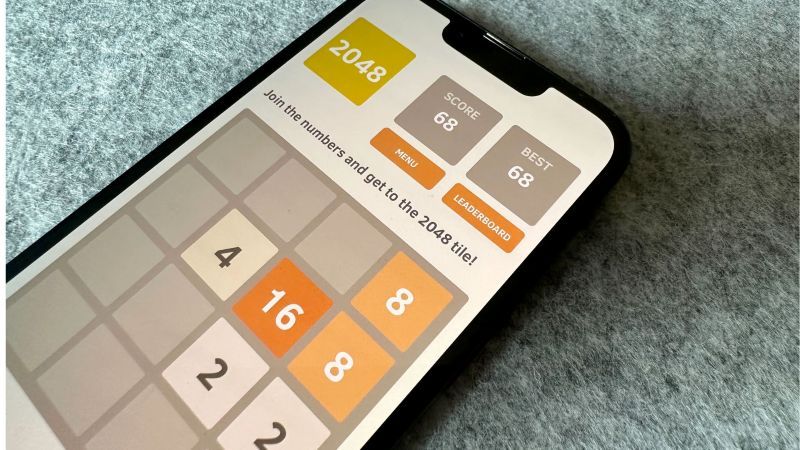
Swipe to slide tiles, merge equal numbers to double them, and keep the board alive until you build the 2048 tile and beyond. In practice, high scores in 2048 come from a repeatable control system: commit to one corner, maintain a descending snake pattern, and manage spawn risk so you never break structure for a tempting merge.
Next, you will learn 12 savage lessons that turn random swipes into pro-level board control, helping you reach 2048 faster and push past it with confidence.
The Core Rules of 2048
Before tactics, lock in the basics.
What happens on every move
- All tiles slide as far as possible in the swipe direction.
- Matching tiles merge once per move per tile chain.
- After your move, a new tile (usually 2, sometimes 4) appears in an empty cell.
- You lose when the grid is full and no merges are available.
The entire game is a battle between:
- Creating merges to free space
- Avoiding clutter that blocks future merges
The Pro Mindset: 2048 Is a Space-Control Game
Every pro lesson below supports one principle:
- Your score is a byproduct of space plus structure.
If you keep structure, merges become easy. If you lose structure, the board becomes a trap.
Savage Lesson: Pick a Corner and Never Betray It
Pros commit to a “home corner” where the biggest tile lives.
Why the corner strategy works
- Corners reduce the directions your largest tile can drift.
- You can build a stable “snake” of descending tiles behind your max tile.
- You minimize random tile placement damage.
How to execute it
- Choose a corner, for example bottom-right.
- Your default swipes become two directions that keep tiles pressed into that corner, usually:
- Down and Right most of the time
- Only use the other two directions as emergency tools, not as regular moves.
If you let your biggest tile leave the corner, you create chaos that takes many moves to repair.
Savage Lesson: Build a Snake, Not a Pile
A good 2048 board is not “big tiles everywhere.” It is a clean ordering.
The snake concept
Imagine your tiles arranged in a line of descending values that snakes across the board, such as:
- Highest tile in the corner
- Next tiles decreasing along the edge
- Then continuing in a row beneath, like a zigzag
Why it works:
- Every merge pushes value toward your corner.
- You reduce situations where a large tile blocks a needed merge.
What to avoid
- Two large tiles separated by clutter
- Large tiles in the center
- Equal tiles trapped behind bigger ones
You are not collecting. You are organizing.
Savage Lesson: Protect Your “Main Lane” at All Costs
The main lane is the edge line where your highest tiles live.
What main lane protection means
- Keep the row or column of your corner tile clean and descending.
- Avoid inserting small tiles into that lane unless they will merge soon.
- Treat lane disruption as a crisis.
How to keep the lane clean
- Prefer moves that compress tiles toward your lane.
- Merge small tiles away from the lane first, then feed the results in.
If your lane stays clean, everything else becomes solvable.
Savage Lesson: Use Two Directions as Your Default Moves
A pro does not swipe randomly. A pro has a default rhythm.
The safe two-direction loop
If your corner is bottom-right, the safe loop is often:
This keeps:
- Your largest tile anchored
- Your board compressed
- Your merges predictable
When to break the loop
Only when you have a clear reason:
- to create a merge that frees multiple cells
- to prevent a lock in the opposite corner
- to fix a blocking tile that threatens your lane
If you cannot explain the reason in one sentence, do not break the loop.
Savage Lesson: Merge Small Tiles in a “Workshop Zone”
Pros avoid mixing small-tile chaos into the high-value structure.
The workshop idea
Your board has two regions:
- The power zone: where big tiles live (near your corner and main lane)
- The workshop zone: where you combine 2s, 4s, 8s into usable pieces
How to apply it
- Let new tiles spawn and combine mostly away from your corner.
- Only move a tile into the power zone when it supports a planned merge chain.
This prevents the classic failure where a random 2 blocks your entire lane.
Savage Lesson: Stop Chasing Merges That Break Structure
A merge is not always good. A merge can be bait.
The savage rule
- Never take a merge that forces your highest tile out of position or breaks your lane.
A tempting merge can cost you:
- corner control
- board compression
- long-term merge potential
Pros choose structure over dopamine.
Savage Lesson: Always Track Your Next Spawn Risk
Every move adds a new tile. That means every move must be judged by “what happens if a 2 spawns in the worst place?”
How to manage spawn risk
Before you swipe, check:
- How many empty cells will remain?
- Which cell is most dangerous if filled?
- Will this move create a blocked row with no merges?
A simple risk rule
- If you have very few empty cells, only make moves that create merges immediately.
When space is low, “setup moves” become lethal.
Savage Lesson: Keep the Board Compressed, Not Scattered
Compression means your tiles are packed together in predictable order.
Why compression matters
Scattered tiles create:
- isolated values
- dead merges
- forced swipes that break your corner
How to maintain compression
- Use your two safe directions to keep everything tight.
- Avoid moves that spread tiles across the grid unless it creates a major merge chain.
A tight board is a readable board.
Savage Lesson: Learn the “One Bad Swipe” Fail Pattern
Most games of 2048 end the same way:
- one swipe moves your max tile off-corner
- the next few swipes try to fix it
- the board fills while you are repairing
- you lose with no merges available
How to prevent the spiral
- If a move risks dislodging your corner tile, do not make it.
- If you must make it, plan the recovery immediately:
- two moves to re-anchor
- then rebuild the lane
A pro does not avoid mistakes perfectly. A pro prevents mistakes from becoming disasters.
Savage Lesson: Build Equal Tiles Near Each Other On Purpose
Merges do not happen by chance at high levels. You must “manufacture” matches.
How to manufacture matches
- Combine smaller tiles into a target value in the workshop zone.
- Position that target adjacent to its matching tile in the power zone.
- Use one safe-direction swipe to merge cleanly.
Practical example mindset
If you already have a 128 in the lane, you want to craft another 128 nearby. That means your workshop goal becomes:
- build 64 plus 64
- then feed it into position
This is how pros climb past 2048.
Savage Lesson: Do Not Let Your Second-Largest Tile Drift
Your max tile is the king. Your second-largest tile is the guard that keeps the structure stable.
Why the second-largest matters
- It supports merges into the max tile.
- It prevents random tiles from occupying the critical adjacent space.
How to manage it
- Keep it next to the max tile, along the main lane.
- Avoid moves that separate them with low tiles.
When your top two tiles are aligned, the rest of the board becomes manageable.
Savage Lesson: Endgame Discipline Is Different From Early Game Speed
Early game feels forgiving. Endgame demands restraint.
Early game priorities
- establish corner control
- compress the board
- build a clean snake
Endgame priorities
- protect the lane
- create immediate merges
- avoid any swipe that increases clutter
A pro does not “play faster” in endgame. A pro plays safer.
A Quick Pro Checklist You Can Use Every Turn
If you want a simple decision system, use this:
- Is my biggest tile still in my chosen corner?
- Is my main lane still descending?
- Will this swipe create a merge or create space?
- Does this swipe increase scatter or improve compression?
- What is the worst spawn, and can I survive it?
If you cannot answer these quickly, slow down. Speed kills good boards.
Common Beginner Mistakes That Stop You at 256 or 512
If you keep plateauing, it is usually one of these:
- Switching corners mid-game
- Fix: commit to one corner.
- Using all four directions equally
- Fix: two-direction default loop.
- Chasing merges in the center
- Fix: workshop zone for small merges.
- Breaking the lane for a small merge
- Fix: prioritize structure over micro-points.
- Ignoring spawn risk
- Fix: when space is low, only make merge-producing moves.
Capybara Clicker: Consistency and Upgrade Discipline Win Long Sessions
Capybara Clicker rewards a simple truth: steady, repeatable actions plus smart upgrade timing outperform frantic clicking. That same mindset is how you master 2048: keep a consistent corner strategy, protect your core pattern, and make disciplined moves that build long-term value instead of chasing short-term merges.
FAQ
How to play 2048?
Swipe to move tiles. When two equal tiles collide, they merge into one tile with double value. Keep merging to create bigger tiles and avoid filling the board.
What is the goal of 2048?
The classic goal is to create a 2048 tile, but many players continue beyond it to chase higher scores and larger tiles.
What is the best corner strategy in 2048?
Pick one corner for your largest tile and keep it there. Use mostly the two directions that keep tiles pressed into that corner.
Should I use all four swipe directions?
No. High-level play uses two directions most of the time and uses the other directions only when necessary to prevent locks or create critical merges.
Why do I lose even when I merge a lot?
Because merges that break structure create clutter. 2048 is about space control and tile ordering, not just merging.
What is the snake pattern in 2048?
It is an ordered layout where tiles descend from the largest tile in a corner through the grid in a zigzag. It keeps merges predictable and reduces chaos.
How do I get past 2048?
You must manufacture equal high-value tiles intentionally: build them in a workshop zone, then feed them into your main lane for clean merges.
What should I do when the board is almost full?
Only make moves that create immediate merges or free space. Avoid setup moves that rely on future spawns.
Is it better to merge small tiles quickly?
Yes, but do it in a controlled area away from your main lane. Keep your power zone reserved for high-value structure.
Whata the most common reason players get stuck at 512?
Breaking corner control and scattering mid-size tiles, which forces bad swipes and fills the board with unmergeable clutter.
Final takeaway
If you want to master how to play 2048, stop swiping for merges and start swiping for structure. Choose a corner, build a descending snake, protect your main lane, use two directions as defaults, and manage spawn risk like a pro. Apply these 12 savage lessons consistently, and 2048 shifts from a luck-based puzzle into a controlled, high-streak strategy game where your scores keep climbing in 2048.